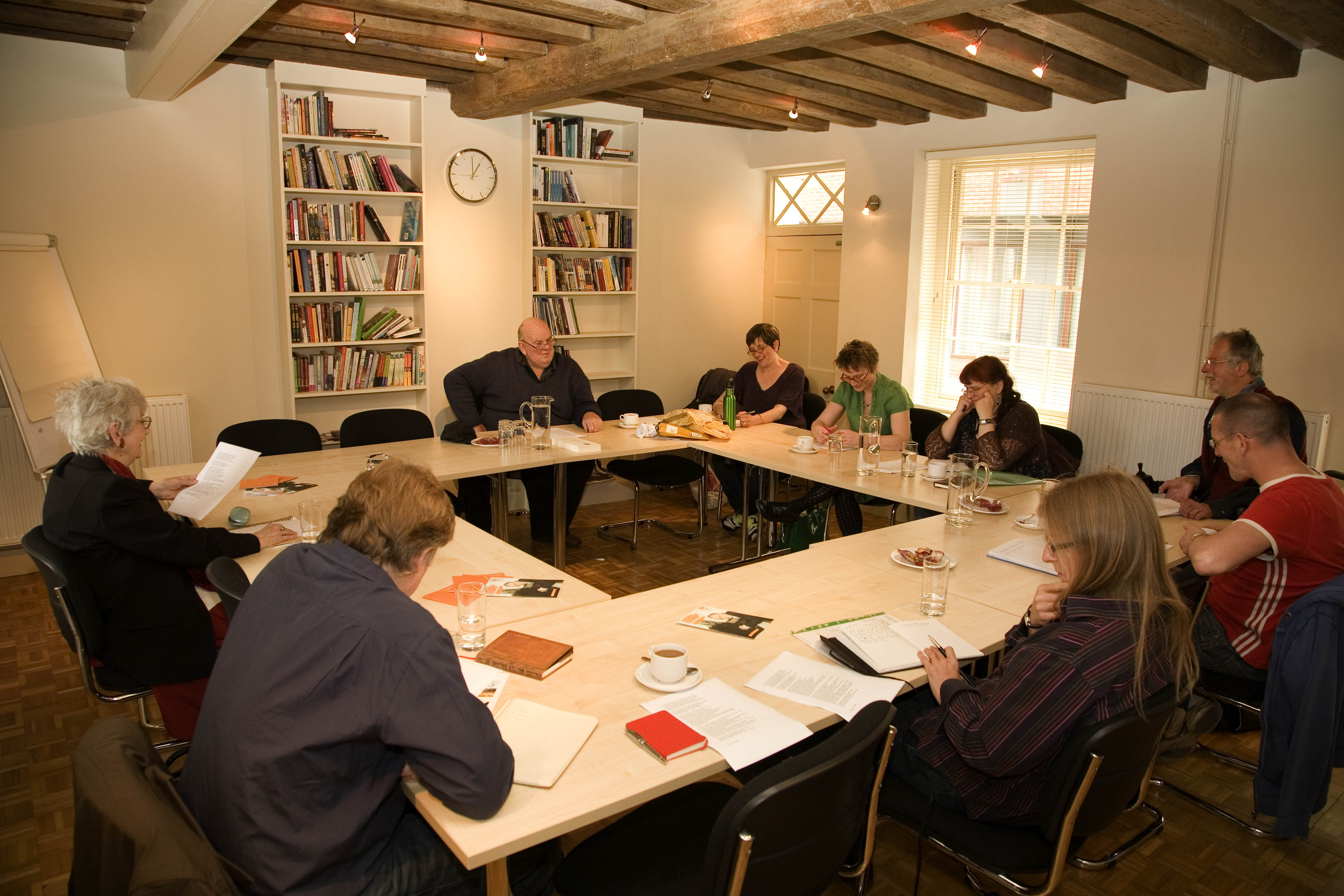
The workshop—if you’ve had the pleasure of participating in one before, it’s the thing writers love to hate. If you’re unfamiliar with a workshop setting, allow me to set up a scene.
Imagine, you’re sitting around a circular table with fifteen other creative writing students. You turned in your story last week, and now it’s time for it to be workshopped. You are filled with a feeling of pure, existential dread at the thought of people discussing and critiquing something that you toiled, sweat and cried (or maybe that’s just me) over. You are forced to sit in silence as a twenty year old guy in a tweed sweater points out every inconsistency with your characters and plot. You wonder why he’s wearing a sweater when it’s 91 degrees outside. You sit in agony as the girl next to you suggests that you change the entire story to first person. I did that for a reason Angela, jeez. However, it’s not the painful process of a workshop that raises controversy in the community of creative writers—it’s the outcome that the structure allegedly has on a writer’s developing craft. It’s an age-old debate, and many writers from all levels of expertise have put in their two cents on the subject.
I, personally, love the workshop setting. It not only forces me to get over my crippling fear of criticism, but also gives me the opportunity to get my writing seen by others who might know a thing or two about the subject. I’ve always left workshops with valuable (and some not-so-valuable) feedback that has helped me immensely in future revisions. Alison Gerber, in her article “The MFA in Creative Writing: The Uses of a ‘Useless’ Credential,” agrees with me (or, better said, I agree with her) that the workshop is an unpleasant, but overall helpful method of enhancing a writer’s craft. She writes that the workshop does not attempt to “teach” a student in the traditional way, but rather gives them a space in which they can use to exercise and enhance their own skills in an environment filled with individuals who also value the craft of creative writing. Kelly Ritler, in his article, “Comments on the Issue Creative Writing in the Twenty-First Century,” claims that the workshop is not, in fact, “a monolith,” but rather “the varied practice that exists across [a particular MFA program’s] courses.”
However, not everyone shares this point of view.
In an article from The Guardian, it’s expressed that renowned author and professor Hanif Kureishi believes that “creative writing courses are a waste of time.” and that the people he has encountered in workshops are largely “talentless” (ouch). He suggests that “the best things [he] learned, [he] learned outside of university: going to poetry open mic nights, bouncing ideas off friends, getting in touch with writers [he] admired and asking for their advice.”
While these things are a great supplement to a young writer’s education, I don’t exactly means that should deem a workshop worthless–it’s merely another form of “bouncing ideas off friends,” except your peers in workshops are much less likely to sugar coat things for you.
Oh! And here’s another article slandering my beloved workshop class! Goody!
John Warner writes in his aptly-named article, “Questioning the Undergraduate Creative Writing Workshop,” actually makes some good points. He doesn’t go as far as to say the workshop is completely ineffective, but rather points out the flaws in a system that could work better. He claims that he is “a product of the workshop, and [he has] achieved more success as a writer than [he] ever would’ve dreamed,” but still has criticisms toward the structure. He claims that the creative writing workshop, particularly that at an undergraduate level, provides validation more than anything–which can be harmful to someone who just doesn’t possess the writing chops it might take to be successful in the publishing world. This makes sense to me, as I’ve witnessed firsthand as terribly underdeveloped, or just poorly written stories have been lauded as masterpieces for the sake of preserving people’s feelings. This doesn’t do anything for the writer except for set them up to be embarrassed in the professional world.
It’s not at all my place, or my purpose in writing this blog, to say that these opinions are wrong or that mine are right. The thing about workshops is that not everyone can thrive in that setting, which is completely understanding. Some people would rather pull a Stephen King and isolate themselves in a cabin for months at a time, and that’s completely respectable. However, I do hope that these different perspectives on the debate can help you decide if you’d like to pursue a structured creative writing course, or whether a workshop might help you develop your own writing (which, in the end, is all that matters).

 Writer's Block